
Walk on Wood: The Beauty and History of Reclaimed French Wood Flooring
Walk on Wood: The Beauty and History of French Reclaimed Vintage Wood Flooring
There’s a particular magic in stepping onto a floor that has already lived a life. Reclaimed vintage wood flooring brings that feeling home—quietly, confidently, and with a patina that only time can teach. Every board carries a biography: saw marks from an old mill, sun-faded edges from decades of window light, nail holes from a barn beam, the slight undulation of hand-planed surfaces. Together, those traces create a warmth and authenticity that new materials struggle to match. In homes and businesses alike, reclaimed floors don’t just finish a room; they ground it—with beauty, history, and the kind of character you can feel underfoot.
A Short History Written in Long Grain
For centuries, wood was the structural and aesthetic backbone of buildings the world over—farmhouses and mills, warehouses and workshops, urban row houses and rural chapels. Much of that timber came from slow-grown, old-growth forests: dense, tight-grained, and remarkably stable. When older structures reach the end of their original purpose, careful deconstruction allows those boards and beams to be salvaged, cleaned, and milled into new flooring. It’s not a replica of the past; it is the past, recast for modern life.
Different regions contribute different species and personalities: American heart pine with its resinous glow, oak with its stubborn strength and high tannin content, Douglas fir with warm orange undertones, chestnut with its subtle luster, and maple with its pale, elegant grain. In Europe, reclaimed oak—particularly French and Central European—has become a shorthand for quiet luxury, its tannins responding beautifully to fuming and reactive finishes that coax out earthy browns, mushroom greys, and subtle olive tones. Wherever it originates, vintage wood tells you where it’s been the second you lay eyes on it.
Why Reclaimed Looks—and Feels—Different
The first thing you notice about reclaimed flooring is the patina. Time oxidizes wood fibers, deepening color far beyond what stains alone can do. Sunlight, air, and years of use create tone-on-tone variation that reads as depth rather than decoration. Light wire-brushing can reveal the earlywood/latewood contrast in the grain, while a natural oil or hardwax finish tends to emphasize detail without a heavy, plastic sheen.
Then there’s the surface history: old saw kerfs, peg holes from timber framing, small checks at the end of boards, mineral streaks where iron met tannin, even the occasional patch from an antique repair. In a well-milled floor, those marks are not defects—they’re evidence. They signal honesty and longevity, turning a surface into a story. Add to that the proportions reclaimed stock often allows—wide planks, longer lengths—and rooms feel calmer and visually larger, with fewer seams interrupting the eye.
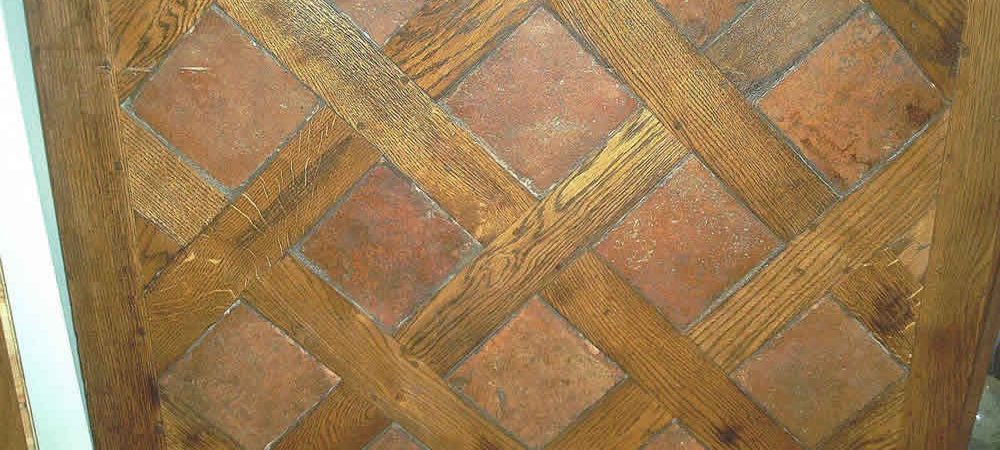
Patterns that originated in grand settings—herringbone, chevron, and Versailles panels—gain fresh nuance when laid in reclaimed material. Softened edges and gentle shade shifts keep geometry from feeling rigid, letting the pattern breathe and the space relax.
Durability You Can Live On
Wood species like oak, heart pine, and maple are inherently durable, but reclaimed stock offers advantages that go beyond species. Old-growth timber grew slowly, yielding tight growth rings and dense fiber. After decades (or centuries) of service, the wood has already done most of its moving—seasoned by time, it’s less prone to the dramatic expansion and contraction new wood can exhibit when indoor humidity swings.
That stability translates to floors that wear their years gracefully. In a boutique, restaurant, or gallery, scuffs become part of the charm rather than eyesores. At home, a dog’s paws or a child’s toy leaves marks that blend in rather than shout back. And whether you choose solid planks or a high-quality engineered construction with a thick wear layer, reclaimed flooring can often be refinished multiple times, stretching its useful life across generations.
The Sustainability Story—Real, Tangible, and Local
Reclaimed flooring is sustainability you can see and touch. By reusing wood that was harvested long ago, you avoid cutting new trees and reduce embodied energy compared to milling, kiln-drying, and transporting freshly cut lumber. You also keep valuable material out of landfills and support local craft economies—demolition experts, metal detectors, sawyers, kiln operators, and finishers who bring skill to every step.
Responsible suppliers will document provenance where possible and follow rigorous processing: thorough de-nailing, metal detection (to protect blades and your future nails), kiln sterilization to eliminate pests, careful milling, and grading that respects the wood’s history while ensuring it performs like a modern floor.
Solid vs. Engineered: Which Is Right for You?
Both formats can be excellent—your site conditions and goals decide.
- Solid reclaimed wood is the classic choice, ideal over plywood subfloors in relatively stable humidity conditions. It’s the champion of longevity, with the potential for many sand-and-refinish cycles over its life.
- Engineered reclaimed wood marries a thick reclaimed wear layer (aim for 4–6 mm or more) to a balanced, cross-laminated core. The result is excellent dimensional stability—perfect for radiant heat, concrete slabs, or wider planks in climates with bigger moisture swings. High-quality engineered floors look and feel indistinguishable from solid once installed, while offering more installation flexibility.
Finishes That Honor the Material
The finish is the final handshake between wood and light. Popular options include:
- Hardwax oils for a matte, tactile look that’s easy to spot-repair and refresh—great for homes and boutique commercial spaces.
- Lye/soap systems that keep tones pale and powdery, beloved in Scandinavian-inspired interiors.
- Low-VOC waterborne polyurethanes that add a bit more surface protection in busy environments while avoiding high-gloss plastic shine.
- Reactive stains/fuming that leverage oak’s tannins to build color from within the wood rather than on top of it. (Best left to experienced finishers for consistent results.)
Whatever you choose, the goal is the same: highlight the grain, not hide it.
Installation and Care: The Gentle Arts
Reclaimed wood rewards thoughtful preparation:
- Acclimate the boards to your space until they balance with the room’s temperature and humidity.
- Prepare the subfloor—flat, clean, dry, and tested for moisture.
- Blend bundles as you lay out to distribute color and character evenly.
- Glue-assist on wider planks to minimize seasonal movement.
- Protect during construction with breathable coverings (skip plastic that can trap moisture).
Daily care is refreshingly simple: dust or vacuum grit, damp-mop with wood-safe cleaners, add felt pads under furniture, and use entry mats. Oiled floors can be revived with a maintenance oil; factory-finished or poly-coated floors may just need a light abrade and recoat after years of service. Because variation is baked into the look, ordinary wear tends to disappear into the story rather than fight it.
Where Vintage Shines: Homes and Businesses
In a home, reclaimed wood tempers minimalism with warmth, makes a farmhouse kitchen feel genuinely rooted, or turns a bedroom into a cocoon. It complements stone, plaster, linen, and wool; balances metal, glass, and concrete; and invites natural light to play across the grain from morning to evening.
In commercial spaces, reclaimed floors telegraph authenticity. Guests notice—even if they can’t say exactly why—that the place feels grounded and intentional. For a retail shop, it frames merchandise without competing. For a café, it softens acoustics and puts patrons at ease. For a gallery, it offers a neutral, storied backdrop that doesn’t upstage the art.
Choosing Well: A Quick Checklist
- Provenance & processing: Ask how and where the material was sourced, and confirm de-nailing, kiln sterilization, and metal detection.
- Moisture & milling: Look for consistent moisture content and precise milling for tight seams.
- Wear layer (engineered): Verify thickness if you plan to refinish in the future.
- Sample honestly: Request samples that reflect the range of the batch—color, knots, marks—not just the prettiest boards.
- Finish tests: Try your finish on a few boards before committing to understand how the tones will shift.
Walking on Story
More than any other surface in a room, floors set the tone—and few do it with the quiet authority of reclaimed vintage wood. This is beauty with a backbone, elegance with evidence, sustainability that doesn’t demand a sacrifice in style. Every footstep is a conversation with the past, carrying forward craftsmanship and care into the spaces where you live, work, gather, and create.
Walk on wood. Walk on history. And let a floor with a life already lived enrich the one you’re living now. Contact us and download our catalogue for additional stone flooring options.
Looking for something specific? We offer custom sourcing for hard-to-find materials and unique requests.